jeudi 22 octobre 2015

about funds, sicafi, and others ...


Dimensional Fund Advisors

Dimensional fund advisors

Dimensional Fund Advisors (DFA ou Dimensional) est une société d’investissement basée à AustinTexas avec des bureaux régionaux à Amsterdam, Berlin, Londres, Santa Monica, Sydney et Vancouver. La société a été créée en 1981 par David G. Booth et Rex Sinquefield, diplômés de l’Université de Chicago.
Les objectifs de DFA sont de « faire bénéficier aux clients de la performance des marchés de capitaux et d’accroître les rendements à l’aide d’une construction de portefeuille » 1,2. Myron Scholes et Robert C. Merton, prix Nobel en Économie siègent au conseil d’administration de la société. Merton Miller, un autre prix Nobel d’Économie, y a également siégé.
La société est détenue par ses employés, ses membres du conseil d’administration et un certain nombre d’investisseurs, y compris le Gouverneur de Californie, Arnold Schwarzenegger.
Les fonds de DFA détiennent plus de $190 milliards sous gestion (septembre 2010). Ils sont fermés au grand public, mais sont ouverts aux investisseurs institutionnels. Les investisseurs privés peuvent y accéder uniquement par le biais de conseillers financiers agréés, payés au frais de conseil exclusivement.

Voir aussi

Voici quelques sociétés de gestion, agréés par DFA :
  • Lyra Wealth SAGenève, Suisse,
  • Helios-Invest GmbH, Zug, Suisse
  • DDEL Portfolio Solution s.a/n.n., Belgique
  • Augeo Invest Erfurt, Allemagne,
  • Logiver sa, Luxembourg.

«  For more than 30 years, we have helped investors pursue dimensions of higher expected returns through advanced portfolio design, management, and trading. Our enduring philosophy and deep working relationships with the academic community underpin our approach to investing and form the foundation for new strategies. 

Our goal is to deliver an outstanding investment experience to every client. Discover how to become one. »


 BEAMA - Belgian Asset Managers Association


BEAMA - Belgian Asset Managers Association

Est l’acronyme de l’asbl qui porte le nom « Association belge des Asset Managers ».
L’asbl BEAMA a pour objet, sans porter atteinte à l’autonomie de ses membres, la représentation et le développement de l’ « Asset Management » en Belgique ainsi que la promotion de son image et de celle de ses membres.


NYRSTAR (NYR)

1,631 EUR Temps réel
-21,92% | -0,46
 22/10/2015 11:39


Nyrstar souffre en bourse, le point sur les titres obligataires

Si l’action Nyrstar connaît sa deuxième séance d’affilée teintée de rouge vif, les titres obligataires du numéro un mondial du zinc évoluent à l’équilibre sur le marché secondaire.
-6,59% hier et jusqu’à -12% aujourd’hui, l'action Nyrstar boit la tasse à la bourse de Bruxelles. Pour cause, l’un de ses concurrents, en l’occurrence le groupe indien Hindustan Zinc, filiale de Vedanta Resources, a décidé d'investir 1,3 milliard de dollars pour combler la réduction de production de zinc annoncée par Glencore.
Il y a deux semaines, le géant anglo-suisse du négoce de matières premières annonçait pour rappel qu'il allait réduire d'un tiers sa production annuelle de zinc, soit environ 500.000 tonnes, pour soutenir les prix actuellement très bas de ce minerai. Une décision qui s'accompagnera de la fermeture des mines de d'Iscaycruz au Pérou et de Lady Loretta en Australie.
Au même titre que les autres matières premières, le zinc souffre des craintes d'un ralentissement plus marqué que prévu de l'activité en Chine, premier acheteur de zinc qui représente au passage près de la moitié de la demande mondiale. Fin septembre, le cours du zinc a d’ailleurs touché un plus bas de cinq ans, ce qui ne manque pas de peser sur les comptes des producteurs.
En tant que leader mondial de la production du zinc, Nyrstar avait profité pleinement de l’annonce de Glencore et de l’espoir de voir les cours remoner. L’action du groupe belge s’était d’ailleurs envolée de 30% en quelques séances.
Mais l’espoir aura donc fait long feu, étant donné qu’Hindustan Zinc devrait dorénavant produire 1,028 milliard de tonnes de zinc par an, contre 850.000 tonnes actuellement, et par là occuper une partie du vide laissé Glencore. 

Stabilité sur le marché obligataire

Sur le marché secondaire, les titres obligataires Nyrstar ne semblent pas trop impactés par la nouvelle. L’obligation remboursable au mois de mai prochain évolue à l’équilibre à 100,25% du nominal (coupure de 1.000 euros). Son rendement annuel s’élève à 4,79% sur base d’un coupon fixe de 5,375%.
L'emprunt Nyrstar (Netherlands) Holding BV, filiale garantie par Nyrstar SA/NV, recule légèrement à 92,25% du nominal. Supérieur à 10%, le rendement annuel reste particulièrement élevé et traduit la prudence des marchés à l’égard de Nyrstar. Cette obligation est disponible par coupures de 100.000 euros et arrivera à échéance en septembre 2019. L'émission est notée « B- » dans la catégorie spéculative chez Standard & Poor’s.

Source

L’Echo, Voici pourquoi l’action Nyrstar décroche


vendredi 16 octobre 2015

Swiss Knife @ New York

GARMIN LTD. (GRMN)

32,64 USD 
+1,12% | +0,36
 16/10/2015 16:14


@


Garmin: A Nice Option In The Wearables Space

Summary

While Fitbit has garnered most of the attention, Garmin makes for an intriguing option in the wearables space.
Garmin carries a forward P/E of 13, no long term debt and a dividend yield of over 5%.
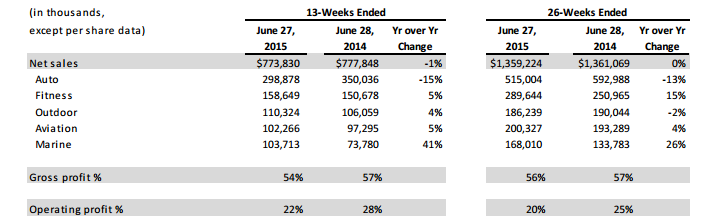
Garmin is predictably seeing declining sales in auto GPS units but it seeing solid growth in both the fitness and marine sectors.
In a recent article I wrote, I offered up Garmin (NASDAQ:GRMN) as an alternative stock to own in the wearables space over the big current names like Fitbit (NYSE:FIT) and Apple (NASDAQ:AAPL). While Garmin's fitness wearable shipments are rising (up 40% year-over-year in Q2), it's the company's diversified product line that helps set it apart.
Garmin has long had a steady if not strong presence in the fitness area. While its product shipments are rising (their Forerunner line of watches are especially popular among runners) the company is still a distant 4th place in the market behind Fitbit, Apple and Xiaomi with just a 3.9% market share. But whereas Fitbit's primary focus is the fitness space, Garmin derives just 21% of its revenue from fitness.
Garmin's big money maker not surprisingly is the automotive area where various versions of Garmin's Nuvi provide roughly 38% of the company's revenue.
(click to enlarge)
That number used to be 44% which would suggest on the surface that the company is becoming less of a one trick pony but the truth is that sales from auto are shrinking. Smartphones and other similar devices have become cheaper and easier to use alternatives to GPS hardware. Using the most recent data available, sales from auto are down 13% year over year which makes it that much more important that other areas pick up the slack.
Despite the fact that Garmin's overall share of the fitness wearables market is relatively small it's an area that is growing quickly and it's a reasonable assumption that growth will continue in this area. The other area that's seeing solid growth is the marine sector where its lineup of chart plotters, fish finders and radar modules has shown nice expansion in the past year.
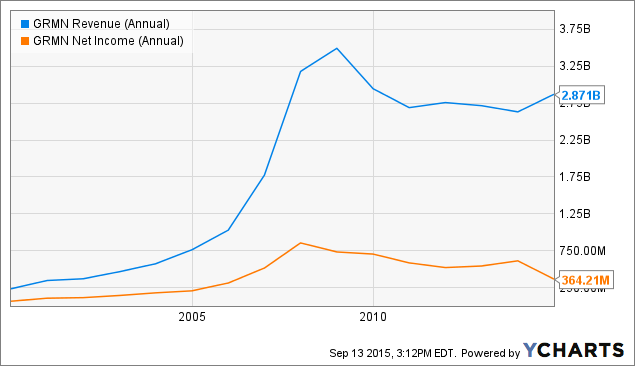
But one of Garmin's challenges is that overall revenues and earnings have flatlined over the past several years.
GRMN Revenue (Annual) Chart
Since Garmin won't be confused for a growth stock any time it's more important to examine fundamentals to determine attractiveness. Garmin currently trades at a forward P/E of just 13 and a P/B of just a hair over 2 - both of which are very reasonable compared to the broad market - and carries no long term debt on its balance sheet. Income investors will be most intrigued by the stock's yield of over 5%. Part of the reason for that yield is the drop in the stock price over the last couple of years but management has committed to the dividend and has in fact been steadily raising it over the last several years.

Conclusion

While auto GPS sales will likely continue their steady decline it looks like Garmin will have other lines of business able to help make up for the shortfall. Its attractive valuation should help provide some downside protection and the dividend will look very attractive to income investors.
Fitbit has been the hot name in wearables and Apple has made its presence felt as well but as we've seen recently growth is not always rewarded. In scenarios like this a high dividend value name like Garmin might make the most sense.


samedi 12 septembre 2015

Lasts about Monte @ BOURSIER.COM


@


Le mariage de Monte Paschi peu probable cette année


par Stefano Bernabei
ROME (Reuters) - La banque italienne Monte dei Paschi di Siena, en quête depuis plusieurs mois d'un partenaire auquel elle pourrait s'adosser, ne devrait pas conclure une alliance avant l'an prochain, en partie à cause d'incertitudes persistantes sur les exigences de fonds propres de la Banque centrale européenne (BCE), a-t-on appris de source proche du dossier.
Monte Paschi, numéro trois du secteur bancaire italien, a été classée l'an dernier par la BCE au dernier rang du classement des grandes banques d'Europe en terme de solvabilité, conséquence de la crise des dernières années et d'un scandale lié à des produits dérivés.
Le groupe a bouclé en juin une augmentation de capital de trois milliards d'euros pour renforcer son bilan mais la BCE lui a demandé en février de trouver un partenaire, sans toutefois lui imposer une date butoir.
Après avoir accumulé 14,6 milliards d'euros de pertes sur la période 2011-2014, la banque a renoué avec les bénéfices au premier semestre de cette année. Mais cela n'a pas suffi à lui permettre de trouver un acquéreur, en partie parce que la BCE ne publiera qu'en novembre les résultats d'un nouveau "processus de revue et d'évaluation" (supervisory review and evaluation process, SERP).
"La banque est déterminée à réaliser la fusion mais pour fusionner, il faut être deux, et en ce moment, personne n'est intéressé", a dit la source.
UBI, la cinquième banque d'Italie, a longtemps été présentée comme le candidat le plus probable à un rapprochement avec Monte Paschi mais elle a écarté l'hypothèse à plusieurs reprises et des sources ont déclaré qu'elle avait engagé des discussions avec Banco Popolare.
INCERTITUDES SUR LES FONDS PROPRES
A l'étranger, les noms des groupes français BNP Paribas et Crédit agricole et ceux des espagnols Santander et Banco Sabadell ont circulé mais chacun d'eux a démenti.
Selon deux sources proches du dossier, la BCE a légèrement relevé les niveaux planchers de fonds propres requis des banques italiennes. Monte Paschi afficherait des fonds propres tout juste supérieurs à ce niveau.
Reste à savoir si cela suffira à convaincre un allié potentiel. Et des repreneurs éventuels pourraient aussi attendre de connaître les résultats du SERP les concernant.
"L'acheteur, quel qu'il soit, voudra savoir si Monte dei Paschi dispose de fonds propres suffisants, même après le SERP, mais aussi s'il a lui-même suffisamment de fonds propres", a expliqué la source.
"La question des fonds propres ne sera pas éclaircie avant novembre et rendra très difficile de commencer à penser à une fusion (...) Il est probable qu'il faudra attendre 2016."
C'est dans ce contexte que Monte Paschi a annoncé jeudi la démission de son directeur financier, Bernardo Mingrone. Le président, Alessandro Profumo, a annoncé son départ en août et l'assemblée générale du groupe qui se réunira la semaine prochaine pourrait approuver son remplacement par Massimo Tononi, qui dirige pour l'instant la Bourse de Milan.
(avec Paola Arosio, Marc Angrand pour le service français)


mardi 25 août 2015

Phillips 66 @ SA by The Value Portfolio


PHILLIPS 66 (PSX)


The Value Portfolio picture


Summary

  • Phillips 66 has seen its share price fall over the past few days.
  • The company has significant growth plans, especially in the midstream sector.
  • Phillips 66 has done an impressive job of rewarding shareholders through buybacks and increasing dividends.

Introduction

The oil crash has struck all and struck hard. It has been relentless and unforgiving, and just when people thought a bottom was near, something came up and made it take another hit. In fact, energy is one of the few sectors in the S&P 500 that is not hitting fresh highs every other day - or so I seem to hear (last week was an exception).
But just like the finance stocks in 2008, every crashing sectors have stocks to pick and stocks to avoid. While the current oil crash has devastated downstream producers, midstream producers had managed to stay fairly stable until recently, and many of the majors have actually seen their downstream sectors growing.
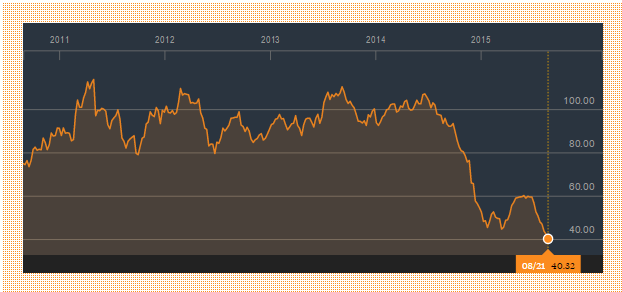
The above image should giving you a hint of what the oil crash has been like. After bouncing from $80 to $100 per barrel for the better part of half a decade, in mid-2014, oil began crashing and crashing hard. After forming a double bottom in January and March just under $50, it recovered to $60 for some time.
Then recently, fresh fears about slowing growth in China, along with the increasing chance of Iran moving huge amounts of oil to the market mean that prices have started tanking again. On August 21, oil prices briefly touched below $40 per barrel - the first time in a long time that they have gotten this low.
Despite all this, Phillips 66 (NYSE:PSX) has remained strong. As a downstream oil company, it has not been as affected by the crash, which is reflected in its stock price. In fact, the company has seen its stock price barely drop from $81 before the crash to its August 21 price of $76 per share - a drop of less than 10%.

Phillips 66 Financial Highlights

Now that we have talked some about the macro oil situation, along with how Phillips 66 specifically has done, it is time to delve into the company's financials.
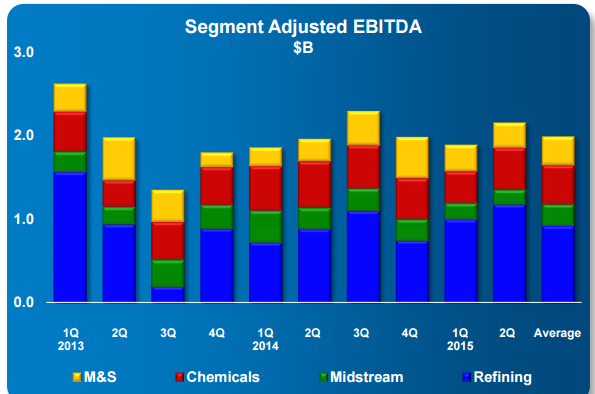
The company has seen its EBITDA hover somewhere between growing and constant. It is worth pointing out that looking at refining quarter by quarter is a poor idea, since it tends to be cyclical on a year-over-year basis.
Still, taking the average of the company's 2013, 2014, and Q1 and Q2 2015 earnings, you'll see that the most recent quarter had above-average earnings. In fact, since 3Q 2014, right around the start of the oil crash, the company has not reported income noticeably below the average - only at the average or above.
This points to the company's continued ability to grow, despite a toughening overall oil situation.
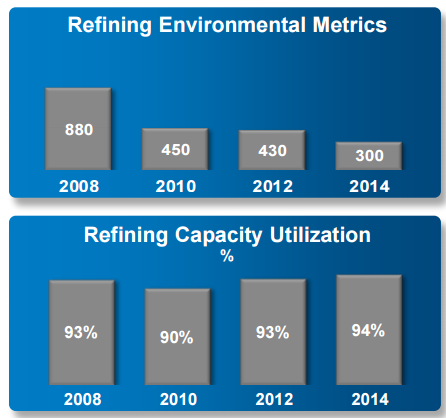
(Phillips 66 Utilization and Environmental Metrics - Phillips 66 Investor Presentation)
Part of this is due to the company's efficiency. Phillips 66 has managed to keep its refining capacity utilized at the low-to-mid 90% level, with the exception of a small drop-off in 2010. More so, on top of keeping its refining capacity constant, the company's environmental metrics (the effect it is having on the environment) have been decreasing.
Oil, compared to other forms of energy like solar and wind, is inherently dirty. The recent protests about Shell (RDS.ARDS.B) drilling in the Arctic should be enough to make investors understand the negative reactions people can have to energy sources that negatively affect the environment.
By decreasing its environmental impact, not only is Phillips 66 decreasing its chances of accidents and potential fines, it is also making itself more favored in the view of people and environmental groups. This should help support its business in the long run.

Strategy

Now that we have talked about the company's financial overview, it is time to talk about its strategy.
(click to enlarge)
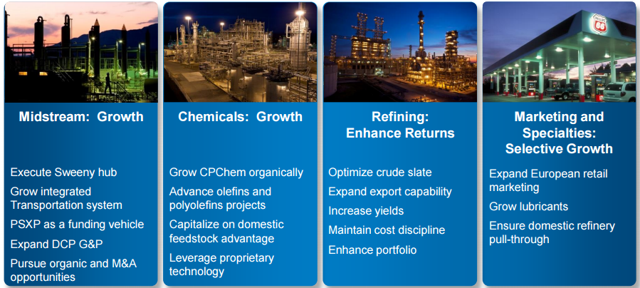
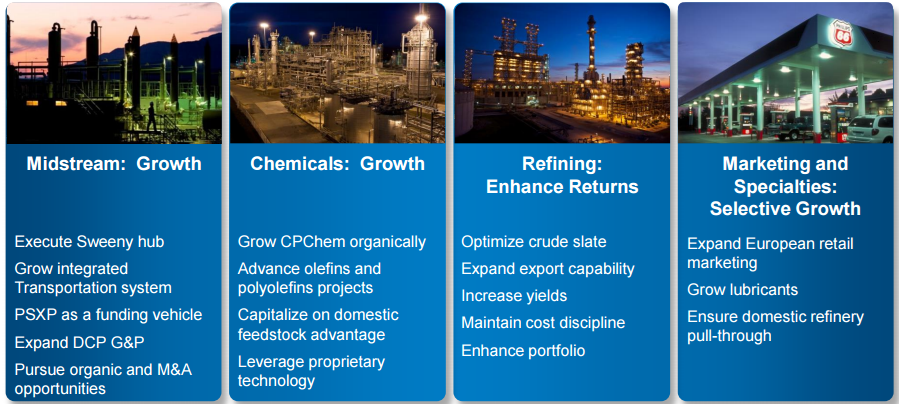
(Phillips 66 Segment By Segment Strategy - Phillips 66 Investor Presentation)
The company operates in four different segments: midstream, chemicals, refining, and marketing and services. It is worth pointing out that out of these four segments, refining is by far the largest, followed by chemicals.
However, despite fluctuations in the other sectors, the company has always gained solid income from its marketing and specialties sector, and this sector will help provide the company with steady earnings.
In the midstream sector, the company is focusing on growing rapidly. It is using Phillips 66 Partners LP (NYSE:PSXP) as a funding vehicle to help it raise capital, since the midstream tends to be a very capital-intensive business.
Most importantly, though, the company has announced its intentions to pursue organic and M&A (merger & acquisition) opportunities.
With many midstream pipeline companies seeing their stock prices take significant hits from 30% to more than 50%, now would be the time for the company to take a significant stance in the midstream space by purchasing a major company in the area.
In the chemicals sector, Phillips 66 is planning on advancing its projects, while growing organically. The company is also planning on taking advantage of several advantages it has, namely domestic feedstock and proprietary technology.
These things should allow it to continue growing in this sector.
In the refining sector, the company's most significant, Phillips 66 is looking to increase its yields and export capacity, while enhancing its portfolio. To me, enhancing your portfolio sounds like fancy talk for looking to acquire additional properties, should the opportunity present itself.
Purchasing additional refineries, especially if the company can grow its selling to customers (marketing and specialities) along with its transport (midstream) capabilities, will provide Phillips 66 with enough vertical integration to grow significantly.
Lastly, in the marketing and specialities category, the company is looking to grow its sale of lubricants. The company is also looking to expand into Europe. Europe has a number of large wealthy economies and should provide significant profits if the company is able to get a firm foothold.

Future Plans

Now that we have talked about the overall market along with the company's financial highlights and its current strategy, it's now time to talk about its future plans.
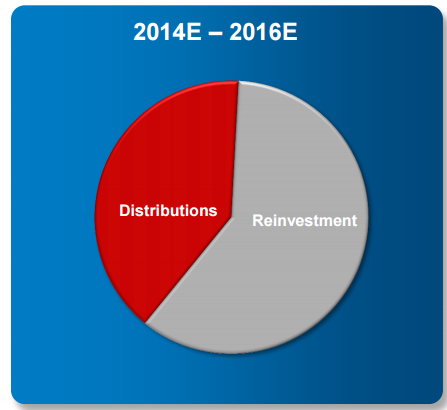
(Phillips 66 2014 through 2016 Distribution and Reinvestment Plans - Phillips 66 Investor Presentation)
The company's 2014-2016 plan involves the majority of its funds going to reinvestment in its business, with a significant portion of its funds paying its distributions.
The above graph makes me happy to see it. The reason for that is because if something should happen where the company sees its earnings draw, it is still a far way from having to cut its distributions.
During such a time of oil turmoil, I want to own companies that will pay me for the risk that I am taking. By covering its distributions by such a significant margin, should things go south, Phillips 66 will continue paying me for my risk.
(click to enlarge)
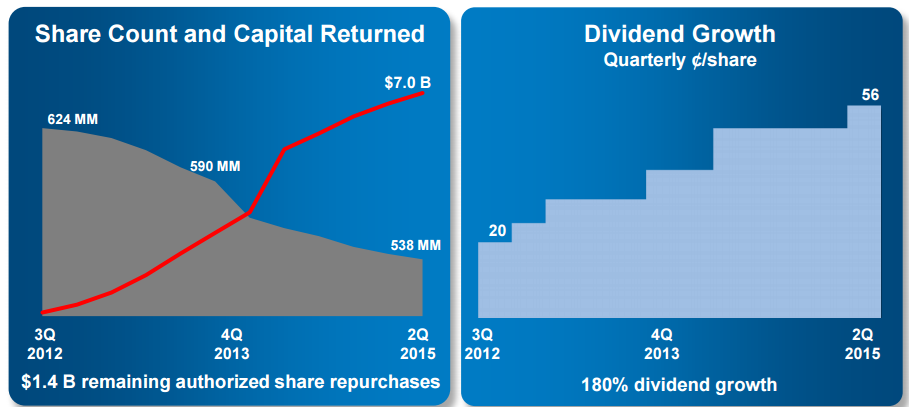
(Phillips 66 Dividend Growth and Buybacks - Phillips 66 Investor Presentation)
This strategy can be reflected in the company's history of helping shareholders. Since being split off from ConocoPhillips (NYSE:COP), Phillips 66 has managed to almost triple its dividends, resulting in $7 billion of capital returned to shareholders.
More so, during this time, Phillips 66 has been buying back shares, managing to reduce its share count by an impressive 14%. It still has $1.4 billion remaining of authorized share repurchases, which should be enough for the company to decrease its share count by another 20 million or so.
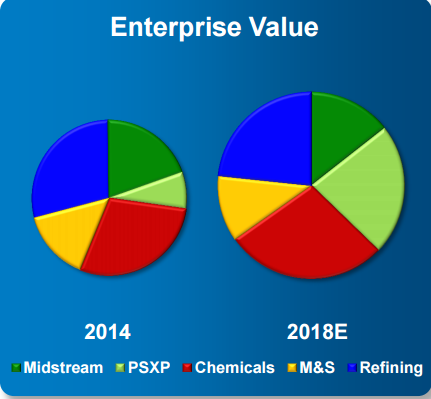
(Phillips 66 Enterprise Value Growth - Phillips 66 Investor Presentation)
More so, despite paying back so much to shareholders, it is still expecting to see its enterprise value grow. In fact, from 2014 to 2018, the company is expecting to see its EBITDA increase by more than 30%, driven mainly by the growing midstream sector.
All of these things together make Phillips 66 a solid buy in the current environment.

Conclusion

Phillips 66, despite its focus on the midstream and the downstream sectors, has seen its stock price fall in the past few days. However, despite this, it is a solid company with solid growth prospects.
The company is planning on heavily expanding in the midstream sector, potentially undertaking some expansions. It has a significant amount of potential ahead of it, and I expect it to continue growing in the long run.
More so, Phillips 66 has done an impressive job of rewarding shareholders. It has already managed to reduce its share count by 15%, and has the ability to increase it by several more percent with the current buyback plan. The company has also managed to triple its dividend since splitting off from ConocoPhillips three years ago.
These things together should help the company continue its growth and make it a solid investment in the oil market.


jeudi 23 juillet 2015

about US STEEL @ DAKOTA


@@@


Stock in Motion: United States Steel Corporation (NYSE:X)


United States Steel Corporation (NYSE:X) shares opened the most recent trading session at 17.250 and at the time of writing the last Bid was at 17.025. In the current trading session the stock reached as high as 17.770 and dipped down to 16.920. United States Steel Corporation, a NYQ listed company, has a current market cap of 2.48B and on average over the past 3 months has seen 8014890 shares trade hands on a daily basis.
On a technical level the stock has a 50 Day Moving Average of 21.490. Based on a recent trade, this puts the equity at -20.777% away from that average. In comparing the stock’s current level to its extended history, the stock is trading -63.426% away from its 52-week high of 46.550 and +1.279% away from the stock’s low point over the past 52 weeks, which was 16.810.
There are a number of Wall Street research brokerages which cover the stock and offer projections on earnings and future stock movement. On a consensus basis, analysts have a one year target price of 25.500. The company’s trailing twelve month (ttm) EPS stands at -0.172. The consensus analyst estimates according to First Call for the next quarter is -0.100. The current year EPS estimate on the stock is -0.590 and the EPS estimate for next year sits at 0.960.
The price to earnings ratio, or the valuation ratio of a company’s current share price compared to its per-share earnings sits at N/A. This is an important indicator as a higher ratio typically suggests that investors are expecting higher future earnings growth compared to companies in the same industry with lower price to earnings ratios. When calculating in the EPS estimates for the current year from sell-side analysts, the Price to current year EPS stands at N/A. Investors looking further ahead, will note that the Price to next year’s EPS is 17.734.

United States Steel Short Interest Up 10.9% in June (X)


United States Steel logo


UNITED STATES STEEL CORP (X)

17,06 USD 
-0,76% | -0,13
 23/07/2015 17:44

Intercooler Online


Shares of United States Steel (NYSE:X) saw a significant increase in short interest in the month of June. As of June 30th, there was short interest totalling 39,392,090 shares, an increase of 10.9% from the June 15th total of 35,535,169 shares,MarketBeat reports. Approximately 27.3% of the company’s shares are short sold. Based on an average daily volume of 6,593,149 shares, the short-interest ratio is currently 6.0 days.
A number of analysts have recently weighed in on X shares. Analysts at Zacks upgraded shares of United States Steel from a “sell” rating to a “hold” rating in a research note on Thursday, July 16th. Analysts at Barclays reiterated a “hold” rating and set a $23.00 price target (down previously from $24.00) on shares of United States Steel in a research note on Thursday, July 9th. Analysts at Deutsche Bank lowered their price target on shares of United States Steel from $42.00 to $37.00 and set a “buy” rating on the stock in a research note on Thursday, July 2nd. Analysts at Morgan Stanley reiterated an “overweight” rating and set a $35.00 price target on shares of United States Steel in a research note on Thursday, May 14th. Finally, analysts at Credit Suisse reiterated an “outperform” rating and set a $40.00 price target on shares of United States Steel in a research note on Tuesday, May 5th. Five research analysts have rated the stock with a sell rating, nine have issued a hold rating and seven have assigned a buy rating to the company’s stock. The company currently has an average rating of “Hold” and a consensus target price of $30.22.
Shares of United States Steel (NYSE:X) opened at 17.19 on Thursday. United States Steel has a 52 week low of $16.81 and a 52 week high of $46.55. The stock has a 50-day moving average of $21.49 and a 200-day moving average of $23.55. The company’s market cap is $2.50 billion.
United States Steel (NYSE:X) last released its earnings data on Tuesday, April 28th. The company reported ($0.07) earnings per share (EPS) for the quarter, missing the consensus estimate of $0.12 by $0.19. The company had revenue of $3.27 billion for the quarter, compared to the consensus estimate of $3.43 billion. During the same quarter in the previous year, the company posted $0.27 earnings per share. The company’s revenue for the quarter was down 26.4% on a year-over-year basis. Analysts expect that United States Steel will post $-0.59 EPS for the current fiscal year.


United States Steel Corporation (NYSE:X) is a steel producer. The Company is engaged in producing flat-rolled and tubular products with production operations in North America and Europe. The Company operates through three segments: Flat-rolled Products (Flat-rolled), U. S. Steel Europe (USSE) and Tubular Products (Tubular). The results of the Company’s railroad and real estate businesses are combined under the Other Businesses category. The Flat-rolled Products segment includes the operating results of all facilities within U. S. Steel’s integrated steel plants in the United States, except the Fairfield pipe facility. The USSE segment includes the operating results of U. S. Steel Kosice (USSK), the Company’s steel plant and coke production facilities in Slovakia. The Tubular segment includes the operating results of U. S. Steel’s tubular production facilities, primarily in the United States, and equity investees in the United States and Brazil.